
Bob “Marz” Marzulli’s legacy will be honored as one of five to be inducted into the Idaho State Athletic Hall of Fame this year.
Dr. James Lynn, the chairman of the committee that oversees the hall of fame, said Mr. Marzulli was chosen because of his commitment to his community.
“We always choose people like Mr. Marzulli,” Dr. Lynn said. “Someone that does everything in town. I personally played football against him many years ago. He was quite a guy.”

He was born in Spokane in 1933 but grew up in Calder, graduating from St. Maries High School in 1952. Mr. Marzulli poured his life into the St. Maries community spending his time teaching, coaching and volunteering in various projects. He died Nov. 15, 2011.
The Idaho State Athletic Hall of Fame was founded more than 50 years ago and honors athletes, coaches and supporters from across the state who are nominated for exceptional qualities.
Mr. Marzulli will join another local man, Mitch Santos, as an honoree. Mr. Santos was inducted in 2004.
The induction will take place in conjunction with the North Idaho sports banquet in April. Dr. Lynn hopes that close friends will step forward to represent him at the presentation.
“It would be great if we could get a group of people to come over and show support for his induction and represent him at the ceremony,” he said.
Anyone interested in participating in and attending the event and/or representing Mr. Marzulli should contact Dr. Lynn at (208) 651-3240.
Ethan Hill
St. Maries Middle School 7th Grader
Winner of the 12-13 boys age group at the Elks Lodge Regional Hoop Shoot

1. At what age did you become interested in the sport of basketball?
I’ve played since an early age. Probably from when I was six or seven. I was always interested in basketball and played with the Upward Basketball Program out at the Nazarene church. And I’ve played AAU and now with the schoolís seventh grade team this year.
2. What made you want to compete in the local Elks Hoop Shoot free throw competition in St. Maries?
It was something my older cousin had mentioned to me. I think he’s a part of the Elks. It was my first time to compete in it. It was pretty fun. I got to compete with my friends.
3. After earning the trip to the regional competition, how often did you practice?
I practiced every day at basketball practice after school and played ball with my friends at their house. We usually have practice every day.
4. Tell us about your experience at the regional competition.
It was really exciting. The guy I went up against was really good. I was kind of nervous. We had 25 shots at first and we both made 19. Then we had a first shoot-off with five shots. He went first and made all five so I knew if I missed I would be going home. But I made five out of five. Then the second time he went he made five out of five so I knew I would have to do it again. The third time he went, he made his first shot and then missed his second and third. He made his fourth and fifth. Then I went. I made my first three and missed my fourth. I knew if I missed my fifth we’d go again so I just made the last shot.
5. How many total shots did you end up making at the regional competition?
39.
6. What are you doing to get prepared for state? And when and where will state be held?
Just what I regularly do. I get to play ball at youth group, and will continue to practice during the week with my seventh grade team. I’m a little nervous about going. This will be my first time ever at a big competition. State is Feb. 14 at Blackfoot. I just hope to play my heart out and do the best that I can.
7. What makes a good free throw shot since that is what the competition is based on?
You just have to be comfortable. You have to line up your foot with the middle of the basket, whichever side you shoot with. I shoot right-handed and so I line up my right foot with the middle of the basket.
8. Are you on a local basketball team? What position(s) do you play?
I play on the seventh grade team (at St. Maries Middle School). I played as part of the Upward program from kindergarten through sixth grade. Pretty much ever since I could. I’m doing pretty good this season. I average about 15 points per game. I play wing and sometimes a high post just depends on the play.
9. What do you enjoy about the sport of basketball?
I just enjoy hanging out with my friends and playing a sport that I like a lot. My goal is to get better at the sport.
10. Do you plan to play the sport in high school?
I want to play in high school. I’m trying to get good enough so I can play on the varsity squad when I’m a freshman and then I’ll be able to play with my brother, Brady Martin, who will be a senior.
Four local businesses return as sponsors for the Ray of Hope Breakfast, March 20. The breakfast, sponsored by Potlatch Corporation, is a fundraiser for Benewah County CASA. CASA provides volunteers for children whose parents are involved in the court system.
Ken’s Custom Body & Paint, The Paperhouse the St. Joe Valley Credit Union and Eimers’ Insurance of St. Maries joined Potlatch Corporation last week as sponsors for the event.
“Our initial response has been good and we know we will have several more local businesses will join us as sponsors,” Dan Hammes, who is helping organize the breakfast, said. “This really is something that deserves support and as with all credible charitable effort, we are certain the St. Maries business community will provide great support.”
The free breakfast is open to the public and will include a short presentation about the Benewah County CASA program.
“Over the next several weeks we contact potential sponsors. We hope to have a long list of contributors to recognize at our breakfast,” Mr. Hammes said.
For more information call the Gazette Record at 245-4538.
A local man made a global impact when he was sent to the front lines to fight the Ebola virus in Africa.
Dale Bates, recently returned from an overseas mission to Liberia, where he helped establish a field hospital tasked with providing care for health care workers who contracted the Ebola virus.
Mr. Bates has lived in the area for 20 years, working first for the Benewah Medical Center and now for the Health Resources and Services Administration (HRSA).

Dale Bates in the supply area of the hospital he helped establish in Liberia to care for health care workers who had contracted the Ebola virus.
His job entails monitoring grant-funded projects for community health centers, occasionally (once a year) it involves field work, where he is deployed to an area for public health disaster relief work.
Mr. Bates is part of a national force of more than 6,800 Commissioned Officers in the U.S. Public Health Service (USPHS).
“We all have a day job but we are also part of a deployable health force that provides emergency response to public health needs,” he said.
In the 19 years he has worked for the USPHS, Mr. Bates has been deployed to a number of locations including the east coast after Hurricane Katrina, the Mexican border, Liberia, Vietnam, Indonesia, Columbia, Haiti and Nicaragua.
“They are usually very unexpected calls,” he said. “I was standing in a stream north of Anchorage, Ala. fishing when I got the call to go to Liberia.”
Mr. Bates was in a team of 65 people tasked with taking a military-grade clinical care unit and turning it into a place to care for international and Liberian health care workers who had contracted the Ebola virus.
The group left for Liberia mid-October and returned in January.
Mr. Bates official duties included logistics and supply at the 25-bed hospital, but conditions made it necessary for him to assist with a variety of duties. He not only worked in supply, but infection control, safety, medical, lab, housekeeping, pharmacy, facilities, dietary and bug control.
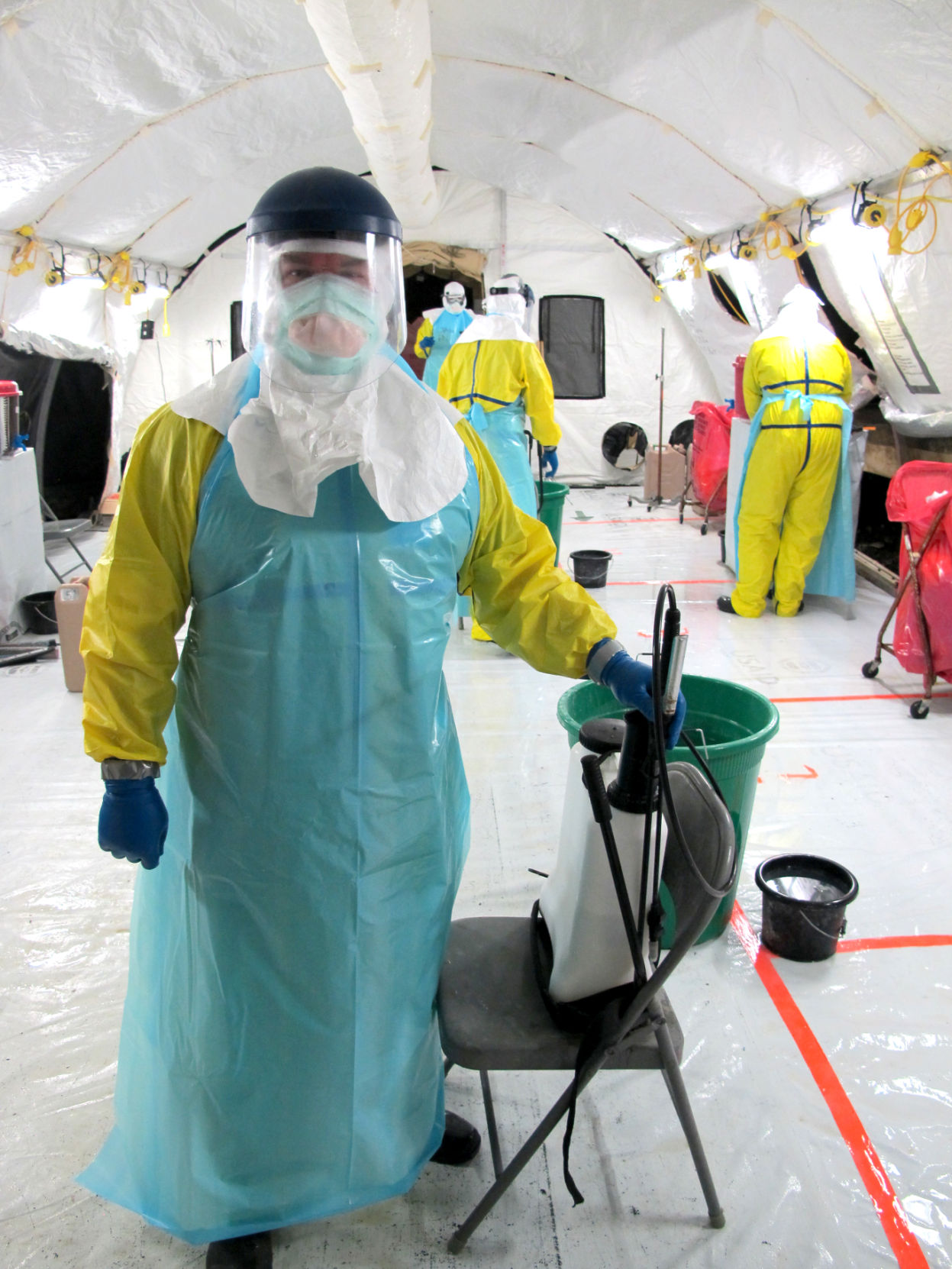
Dale Bates suited up for work in the ward at an Ebola treatment facility in Liberia.
In his two months at the facility, Mr. Bates was able to spend less than two days away from his duties. The team ate ready-to-eat meals (MREs) and took turns working 12-hour shifts, commuting an hour each way from their living quarters and napping about five hours before returning to the hospital. They lived and worked in temperatures of 90 degrees with high humidity and lots of rain.
“Most of our equipment and supplies didn’t arrive until a week before we left, so we had to get really creative and make due with what we could find,” he said. “We had to make a lot of our own supplies and even some of our medicine had to be hand mixed.”
The nature of the virus made even basic tasks arduous.
“It took an hour just to take out the garbage, because you had to put on a suit, collect the garbage from two patient wards and then decontaminate before removing the suit each time,” Mr. Bates said.
The crew used large quantities of chlorine to disinfect everything and burned everything that came out of the wards where patients were kept.
“The chlorine vapors were incredible and it took a month for the bottom of my feet to heal from the chlorine that gathered in my boots,” Mr. Bates said. “It was certainly not comfortable, but we just had to suck it up. Chlorine is very effective at killing the virus, but it only takes a few to become infected.”
Approximately 60 percent of the patients who were admitted survived the virus.
“Just the fact that we had patients recover from Ebola and go back to the workforce to keep at it is a phenomenal accomplishment,” Mr. Bates said. “We didn’t have our first patient discharge for three weeks. We were all getting tired, and working for weeks in difficult conditions, but the moment the first patient put his handprint on that survivor board made it all worth it.”
Upon their arrival, 500 new cases of the virus was discovered each week. The week the team returned, that number had dropped to 100, and there were just four in Liberia last week. As of Jan. 28 the World Health Organization reported that 22,000 people had been infected with Ebola and 8,795 had died in three countries in western Africa.
“They have been successful in getting people into treatment and better at identifying patients with potential exposure,” Mr. Bates said. “The government has also done a good job at influencing the culture’s funeral traditions and convincing people not to have contact with the bodies of those who have died from the virus.”
Mr. Bates said this assignment was the most physically challenging deployment of his career. Their training involved teaching them to protect themselves and each person was screened for emotional strength.
The team was hand-selected by the Office of the Surgeon General.
“It is quite an honor to have been included,” Mr. Bates said. “You do your job a lot of times but this is one of those deployments where you really knew you were representing the U.S. and American people. Everyone on that team was the right choice. They all handled it well. It was the most incredible experience of our lives, and one that we hope to never have to repeat.”
The goal is to turn the hospital over to the Liberian government by late spring or summer.
Mr. Bates lives in St. Maries with his wife Sue, who is a maternal and child health nurse at the Benewah Medical Center. Together they have three grown children.
The St. Maries fire district honored four of their own at an annual banquet dinner earlier this month.
Josh Masterson was named Firefighter of the Year and Hadley McInturff Most Improved for the northern end of the district. Wesley Rice and Brian Bigelow received honors as Firefighter of the Year and Most Improved for the southern portion of the district.

Wesley Rice (left) and Josh Masterson (right) were named firefighters of the year for the St. Maries fire district. Brian Bigelow and Hadley McInturff were noted for being the most improved.
“The four were chosen by their peers for the honor,” Chief Larry Naccarato said. “They stood out from the group and earned the respect of their comrades.”
Mr. Masterson, who works for Mountain Plating by day, has volunteered for the local fire department since April 2013. He also instructs the junior class firefighters. Mr. Hadley, who drives a truck for a living, has been with the district since May 2012. Mr. Rice works for the city of St. Maries and has volunteered for the department the longest of the four, with more than four years on the crew. Mr. Bigelow, who works for Black Rock Ranch ,has been with the district since 2012. He is a captain with the department and is a certified EMT.
The St. Maries district has 31 firefighters, eight in training and eight junior volunteers spread across three stations in the district. Volunteers responded to a total of 108 calls last year.

